Etsy is a marketplace where search visibility directly determines product discovery and sales outcomes. Etsy SEO refers to the optimization methods sellers use to improve how their listings appear in Etsy's internal search results.
This guide explains what Etsy SEO means, how Etsy search evaluates ranking signals, and which specific listing elements influence organic placement. You will learn how keywords, categories, engagement metrics, and customer experience factors interact within Etsy's platform architecture.
The importance of Etsy SEO cannot be overstated. Organic search drives the majority of product discovery on Etsy, making optimization essential for sustainable growth.
Quick Answer
Etsy SEO is the process of optimizing product listings to rank prominently in Etsy's internal search results. It combines keyword relevance in titles, tags, categories, and attributes with performance signals like click-through rates and purchase conversions. Strong Etsy SEO improves product discoverability because Etsy prioritizes listings that match shopper intent and demonstrate consistent engagement.
Key Facts at a Glance
- check
Platform-Specific: Etsy SEO applies to Etsy's internal search system, not Google or external search engines
- check
Metadata-Driven: Listing metadata including titles, tags, categories, and attributes determines initial search relevance
- check
Engagement-Weighted: Signals such as clicks, favorites, and purchases influence ongoing ranking performance
- check
Trust-Based: Customer experience factors like reviews, shipping performance, and shop policies affect rankings
- check
Marketplace Constrained: Unlike Shopify or WooCommerce SEO, sellers cannot control technical infrastructure
- check
Filter-Dependent: Accurate categorization and complete attributes improve visibility in refined searches
What Etsy SEO Means in Ecommerce Context?
Etsy SEO refers to improving product discoverability within Etsy's controlled marketplace environment.
Unlike independent ecommerce stores on Shopify, WooCommerce, or Magento, Etsy sellers operate within an ecosystem where Etsy manages:
- Indexing infrastructure
- Category structure
- Ranking algorithms
- Technical optimization
Core Objective
The primary goal is aligning listings with shopper demand and search behavior patterns.
Listings rank more effectively when Etsy can confidently match product metadata to user queries with high precision.
Why Does Etsy SEO Matter?
For ecommerce sellers, Etsy SEO functions as marketplace-specific organic visibility optimization.
Key Benefits:
- Increases qualified traffic from intent-driven searches
- Reduces dependency on paid advertising
- Improves profit margins through lower acquisition costs
- Creates sustainable traffic channels for long-term growth
Free AI Visibility Checklist for Ecom Stores
A tactical checklist to keep ecommerce products visible in AI search results.
How Does Etsy SEO Differ from Other Platforms?
Every e-commerce platform has its own set of criteria to rank sellers and products. There are a lot of factors involved like customer trust, listing optimization and relevance. Here are key SEO differences between Etsy and other ecom platforms.
Etsy SEO vs Other Platform SEO
| Platform | Technical Control | Ranking Factors | Primary Focus |
|---|---|---|---|
| Etsy | None (platform-controlled) | Relevance + Engagement + Trust | Listing metadata optimization |
| Amazon | None (platform-controlled) | Sales velocity + Ads + Fulfillment | Conversion rate and velocity |
| Shopify | Full control | Content + Backlinks + Technical | Site-wide SEO strategy |
| WooCommerce | Full control | Content + Speed + Structure | Technical + Content SEO |
Key Distinction:
Etsy emphasizes listing relevance and customer experience more than sales velocity, according to Etsy's seller documentation.
How Etsy Search Works: The Complete Process
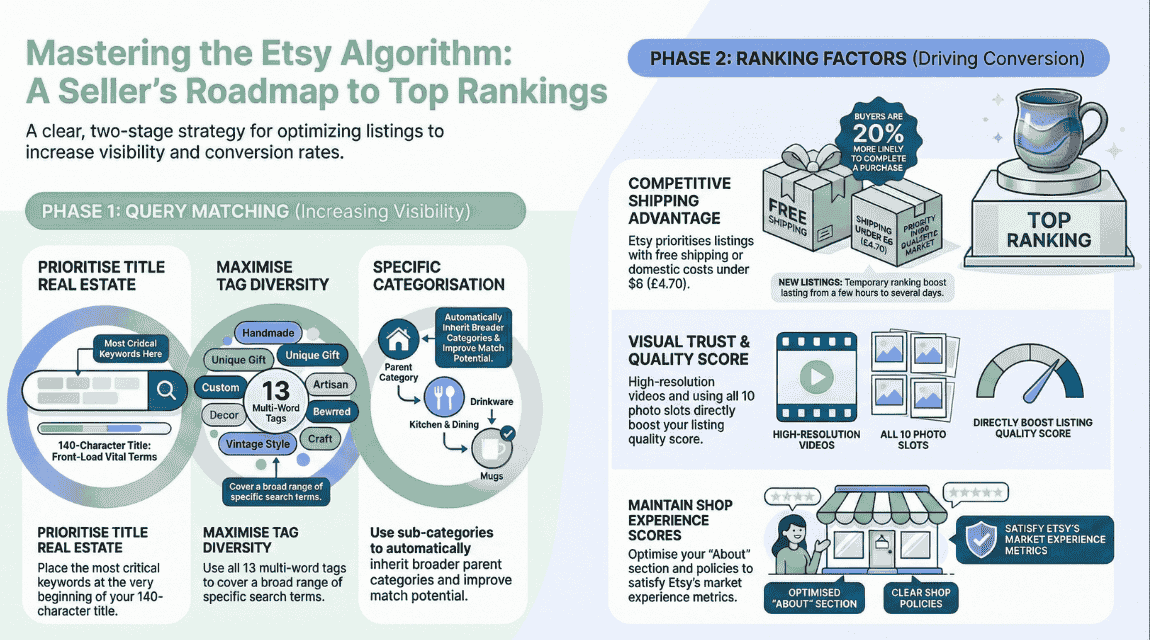
Understanding Etsy's search mechanism is essential for effective optimization. The platform uses a multi-stage ranking process that evaluates both relevance and quality signals.
Stage 1: Query Matching and Keyword Relevance
What Happens: Etsy identifies listings that match the shopper's search terms by evaluating structured listing fields.
Fields Evaluated:
- Listing titles
- Tags (all 13 slots)
- Categories
- Product attributes (material, color, occasion, style)
Why Does This Matter?
A listing enters the candidate pool only when Etsy confirms the product matches the query's explicit and implicit requirements.
Critical Point:
Without proper keyword alignment, a listing cannot rank regardless of other quality factors.
Matching Types:
| Match Type | Description | Example |
|---|---|---|
| Exact Match | Listing contains precise search terms | Search: "leather wallet" → Title: "Leather Wallet" |
| Semantic Match | Etsy recognizes related concepts | Search: "handmade purse" → Category: "Bags & Purses" |
Stage 2: Ranking Signals Beyond Relevance
After identifying relevant listings, Etsy applies additional ranking factors to determine result order. The platform aims to surface listings most likely to satisfy buyer intent and complete transactions.
Primary Engagement Signals:
Click-Through Behavior
- Measures listing appeal from search results
- Higher CTR suggests title and image resonate with searchers
Favorites and Saves
- Demonstrates serious shopper interest
- Signals product consideration phase
Purchase Conversions
- Provides strongest ranking signal
- Confirms listing satisfies buyer needs for specific query
Why Engagement Matters?
These metrics validate listing relevance beyond keyword matching. In practical SEO audits of marketplace platforms, engagement-driven ranking effects consistently appear across competitive categories.
Important Note:
Etsy does not publish complete algorithm details. Treat ranking factors as directional influences rather than guaranteed outcomes.
Stage 3: Listing Quality and Conversion Likelihood
Etsy evaluates listing quality as part of its ranking assessment. Quality improves when shoppers interact positively with product pages and complete purchases successfully.
Quality Indicators:
Visual Presentation
- Clear, professional photography
- Multiple angles and detail shots
- Lifestyle context images
Description Completeness
- Accurate product specifications
- Material and dimension details
- Usage instructions and care information
Competitive Positioning
- Fair pricing for product category
- Transparent shipping costs
- Clear processing timelines
Why Quality Ranks?
Conversion likelihood receives algorithmic weight because Etsy benefits when search results lead to successful transactions.
Platform Alignment:
Etsy generates revenue through transaction fees, creating alignment between platform interests and seller success.
Stage 4: Customer Experience and Shop Trust
Etsy incorporates trust-related factors reflecting seller reliability and customer satisfaction. Rankings improve when Etsy identifies shops that consistently provide positive buyer experiences.
Trust Signals That Impact Rankings:
| Signal Type | Impact Level | How to Optimize |
|---|---|---|
| Review History | High | Maintain 4.5+ star average, respond to all reviews |
| On-Time Shipping | High | Ship within stated timeframes, update tracking promptly |
| Shop Policies | Medium | Complete all policy sections with clear information |
| Customer Service | Medium | Respond to messages within 24 hours |
| Order Issues | High (negative) | Minimize cases, cancellations, and disputes |
Why Trust Matters?
Customer experience affects search visibility because Etsy aims to minimize buyer friction, dissatisfaction, and transaction disputes.
Stage 5: Contextual and Personalized Results
Etsy search results vary based on shopper location, language preferences, browsing history, and device context. Results differ because Etsy attempts to present listings most relevant to individual users.
For global sellers, this creates optimization considerations around shipping regions, currency clarity, language precision, and localized product descriptions.
Personalization improves relevance for shoppers but creates ranking variability for sellers. Etsy search results vary based on shopper context.
Personalization Factors:
- Geographic location
- Language preferences
- Device type (mobile vs desktop)
- Browsing history
- Past purchase behavior
For Global Sellers:
This creates optimization considerations around:
- Shipping regions and costs
- Currency clarity
- Language precision
- Localized product descriptions
How to Do Etsy SEO: Core Optimization Elements
Implementing effective Etsy SEO requires systematic optimization across multiple listing components. Each element serves specific functions in Etsy's search and ranking systems.
Keyword Research for Etsy
Keyword research forms the foundation of any Etsy SEO strategy. The process identifies search terms shoppers use when looking for products like yours.
Primary Keyword Research Methods:
Here are the three methods to perform Etsy keyword research for outranking your competitors.
Method 1: Etsy Autocomplete Analysis
- Type product terms into Etsy search
- Observe suggested phrases
- Note phrase patterns and word order
- Document suggestions for different product variations
Advantage:
Reflects actual search volume and trending queries
Method 2: Competitor Analysis
- Search your target keywords
- Examine top 10 ranking listings
- Note common title structures
- Identify tag patterns in descriptions
- Screenshot successful examples
Advantage:
Reveals what currently ranks well
Method 3: Etsy Search Analytics
- Access Stats section in seller dashboard
- Review "Search terms" report
- Identify keywords driving traffic
- Note conversion rates by keyword
Advantage:
Shows your current performance data
Keyword Selection Framework:
| Keyword Type | Characteristics | Example | Best Use |
|---|---|---|---|
| Broad | 1-2 words, high competition | "leather wallet" | Secondary tags only |
| Mid-Tail | 2-3 words, moderate competition | "mens leather wallet" | Title and primary tags |
| Long-Tail | 4+ words, lower competition | "handmade leather bifold wallet" | Title front-loading |
| Intent-Specific | Includes use case/occasion | "groomsmen gift leather wallet" | Seasonal tags |
Pro Tip:
Balance search volume with competition. Long-tail phrases often convert better because they indicate clear purchase intent.
Title Optimization Strategy
Titles are the most important keyword field in Etsy SEO. The platform gives title content significant weight in relevance matching.
Title Specifications:
- Maximum length: 140 characters
- Front-load important keywords
- Include specific product attributes
- Maintain natural readability
Title Structure Formula:
[Primary Keyword] + [Material/Style] + [Specific Feature] + [Use Case/Occasion]
Examples Comparison:
Weak Title: "Beautiful Handmade Wallet"
Optimized Title: "Handmade Leather Bifold Wallet, Minimal Men's Wallet, Personalized Gift"
Why Does It Work?
- Targets "handmade leather wallet"
- Covers "bifold wallet"
- Includes "men's wallet"
- Addresses "personalized wallet"
- Captures "gift" intent
Title Optimization Checklist:
- Primary keyword in first 50 characters
- Specific material mentioned
- Product type clearly stated
- Style or aesthetic described
- Use case or recipient included
- No keyword stuffing or repetition
- Reads naturally when spoken aloud
Tag Optimization Tactics
Etsy provides 13 tag slots for each listing. Tags help Etsy understand product relevance and match listings to searches.
Tag Strategy Framework:
| Tag Slots | Purpose | Example Tags |
|---|---|---|
| 3-4 tags | Core product keywords | "leather wallet", "mens wallet", "bifold wallet" |
| 3-4 tags | Material and attributes | "genuine leather", "handmade leather", "full grain leather" |
| 3-4 tags | Use case and occasion | "groomsmen gift", "anniversary gift", "fathers day" |
| 2-3 tags | Style and aesthetic | "minimalist wallet", "rustic leather", "vintage style" |
Tag Best Practices:
DO:
- Use all 13 tag slots
- Include multi-word phrases
- Cover different search intents
- Test seasonal variations
- Update based on analytics
DON'T:
- Repeat exact title phrases
- Use single words exclusively
- Include irrelevant keywords
- Copy competitors exactly
- Ignore performance data
Tag Testing Process:
- Week 1-2: Implement initial tag strategy
- Week 3-4: Review search analytics
- Month 2: Replace 3-4 lowest performers
- Month 3: Analyze improvement
- Ongoing: Iterate quarterly
Category and Attribute Optimization
Accurate categorization is essential for Etsy SEO. Category placement determines which browse paths and filtered searches include your listing.
Category Selection Process:
Step 1: Navigate to Most Specific Category
- Start with broad category
- Drill down to most precise subcategory
- Verify category fits product exactly
Step 2: Complete All Attributes
Critical Attributes by Category:
| Category | Required Attributes | Impact |
|---|---|---|
| Jewelry | Material, Color, Style, Occasion | High |
| Home Decor | Color, Style, Room | High |
| Clothing | Size, Color, Material, Style | Very High |
| Art | Medium, Style, Subject | Medium |
| Accessories | Material, Color, Style, Occasion | High |
Why Attributes Matter?
Missing attributes prevent listings from appearing in filtered searches. Shoppers using material, color, or style filters cannot discover listings with incomplete attributes.
Attribute Optimization Checklist:
- Most specific category selected
- All available attributes completed
- Attributes match actual product
- Color options accurately listed
- Material specifications correct
- Size information provided
- Style/aesthetic defined
Etsy Description Optimization
Listing descriptions serve both SEO and conversion functions. While Etsy gives less ranking weight to descriptions compared to titles and tags, descriptions still contribute to overall listing quality.
Description Structure:
Opening Paragraph (SEO-Focused)
- Include primary keyword naturally
- State core product value proposition
- Mention 2-3 key features
Body Sections (Conversion-Focused)
- Materials and construction details
- Dimensions and specifications
- Usage instructions
- Care and maintenance
- Customization options
- Shipping and processing time
Closing Paragraph
- Reinforce unique value
- Address common questions
- Create buyer confidence
Description Template:
[Product Name] - [Primary Keyword]
[One sentence value proposition with primary keyword]
What You Get:
• [Feature 1]
• [Feature 2]
• [Feature 3]
Details:
• Material: [Specific materials]
• Dimensions: [Exact measurements]
• Color: [Available options]
Perfect For:
• [Use case 1]
• [Use case 2]
• [Occasion/recipient]
Care Instructions:
[Brief care guidance]
Shipping:
[Processing time and shipping details]
Platform-Specific Considerations for Etsy SEO
Etsy's marketplace structure creates unique constraints and opportunities different from standalone ecommerce platforms.
Technical SEO: What You Can't Control
Shopify/WooCommerce vs Etsy:
| SEO Element | Shopify/WooCommerce | Etsy |
|---|---|---|
| URL Structure | Full control | Platform-controlled |
| Internal Linking | Custom architecture | Limited to shop sections |
| Schema Markup | Customizable | Platform-managed |
| Robots Directives | Editable | Fixed by platform |
| Site Speed | Optimizable | Etsy-controlled |
| Mobile Optimization | Custom | Standard across platform |
What This Means:
Etsy SEO focuses entirely on listing-level optimization. Technical complexity is eliminated, allowing focus on content and customer experience.
Structured Metadata Requirements
Etsy relies heavily on structured listing fields for search functionality. Titles, tags, categories, and attributes are not supplementary details but primary ranking signals.
Metadata Hierarchy:
Priority 1: Title (highest weight)
↓
Priority 2: Tags (strong weight)
↓
Priority 3: Category (structural placement)
↓
Priority 4: Attributes (filter visibility)
↓
Priority 5: Description (conversion support)
Key Difference from Google SEO:
Traditional SEO allows less structured content to rank through semantic understanding. Etsy requires explicit structured inputs for matching.
Competition Within Shared Categories
Etsy sellers compete within shared category structures. So here is the detailed understanding of how it works:
Competitive Dynamics:
All sellers in "Jewelry > Necklaces" compete for visibility in identical search results and browse paths.
Implications:
Correct categorization = compete against similar products ✗ Incorrect categorization = wasted visibility against irrelevant items
Competitive Analysis Framework:
- Identify Top Competitors
- Search target keywords
- Note top 5-10 consistent rankers
- Document shop details
- Analyze Success Patterns
- Title structures
- Tag strategies
- Image quality
- Review profiles
- Pricing positioning
- Find Differentiation Opportunities
- Keyword gaps
- Underserved niches
- Quality improvements
- Service advantages
SEO Implications for Ecommerce Sellers
Etsy SEO affects business metrics and strategy in specific ways relevant to ecommerce operations.
Organic Traffic Quality Within Etsy:
Traffic Characteristics:
| Metric | Typical Performance | Why It Matters |
|---|---|---|
| Intent Level | High | Etsy search = active product hunting |
| Conversion Rate | 1-5% average | Better than casual browsing |
| Average Order Value | Varies by category | Opportunity for upsells |
| Repeat Purchase | Lower (marketplace dependency) | Platform owns relationship |
Key Insight:
Improved visibility raises conversion rates because search traffic is intent-driven. Shoppers finding products through search are further along the purchase journey.
Impact on Profit Margins
The cost difference between paid and organic traffic significantly affects profitability. Etsy Ads involve variable cost-per-click expenses that can range widely depending on category competition.
Cost Analysis:
Paid Advertising Costs:
- Etsy Ads: Variable CPC (competitive categories)
- External ads: 12-15% commission on attributed sales
Organic SEO Costs:
- Time investment: 2-5 hours monthly per listing
- Tools: $0-50/month (optional)
- Ongoing optimization: Minimal
ROI Advantage:
Organic traffic reduces customer acquisition costs and improves per-sale profitability.
Brand Scaling and Channel Strategy
For brands scaling beyond Etsy, marketplace SEO complements broader ecommerce SEO efforts. Etsy provides product validation and initial revenue while brands build independent presence.
Multi-Channel Framework:
Etsy (Marketplace Validation)
↓
Build customer base + gather data
↓
Launch Shopify store (Owned Channel)
↓
Diversified acquisition strategy
↓
Sustainable brand growth
Strategic Positioning:
| Growth Stage | Etsy Role | Complementary Channels |
|---|---|---|
| Launch | Primary revenue | Social media testing |
| Validation | Product-market fit data | Email list building |
| Scaling | Diversified income | Own website + SEO |
| Maturity | Secondary channel | Multi-platform presence |
Common Etsy SEO Mistakes to Avoid
Understanding common errors helps sellers implement more effective optimization strategies.
Mistake 1: Keyword Stuffing in Titles
Bad Example:
"Leather Wallet Mens Wallet Leather Bifold Wallet Handmade Leather Wallet Minimal Wallet"
Good Example:
"Handmade Leather Bifold Wallet, Minimal Men's Wallet, Personalized Gift"
Why It Fails:
- Unreadable to humans
- Reduces click-through rate
- May trigger Etsy penalties
- Appears spammy
Mistake 2: Using All 13 Tags with Identical Keywords
Some sellers repeat the same keywords across multiple tag slots. This wastes opportunities to expand keyword coverage and does not provide additional ranking benefit.
Bad Tags:
- leather wallet
- leather wallet men
- leather wallet handmade
- wallet leather
- wallets leather
Good Tags:
- leather wallet
- mens bifold wallet
- handmade wallet
- groomsmen gift
- anniversary gift
Fix Strategy:
Each tag should introduce new keyword variations or search contexts.
Mistake 3: Ignoring Attribute Completeness
Missing attributes prevent listings from appearing in filtered searches. Shoppers using material, color, or style filters cannot discover listings with incomplete attributes.
Impact Analysis:
| Scenario | Visibility Loss | Why |
|---|---|---|
| Missing color attribute | 30-40% | Cannot appear in color filters |
| Missing material attribute | 25-35% | Excluded from material searches |
| Missing style attribute | 20-30% | Lost refined discovery |
| Missing occasion attribute | 15-25% | Missed gift searches |
Solution:
Complete every available attribute field, even if it seems minor
Mistake 4: Generic or Vague Descriptions
Descriptions that lack specificity fail to answer buyer questions or establish purchase confidence. Generic descriptions reduce conversion rates even when listings achieve search visibility.
Generic Description:
"This is a beautiful handmade wallet. Made with quality materials. Great gift. Ships fast."
Specific Description:
"Handcrafted from full-grain vegetable-tanned leather. Measures 4.5" x 3.5" when closed. Holds 6-8 cards plus cash. Develops rich patina over time. Hand-stitched with waxed thread for durability."
Difference:
- Specific materials (full-grain, vegetable-tanned)
- Exact dimensions
- Capacity details
- Unique benefits (patina development)
- Construction method
Mistake 5: Neglecting Shop-Level SEO Factors
Focusing exclusively on individual listings while ignoring shop policies, About sections, and announcement areas misses optimization opportunities.
Shop-Level SEO Elements:
- Complete About section with keywords
- Upload shop banner with branding
- Create logical shop sections
- Write announcement with current promotions
- Complete all shop policies
- Add FAQ section
- Link social media profiles
Impact:
Complete shop profiles build trust and provide additional keyword context for Etsy's algorithm.
Mistake 6: Setting and Forgetting Listings
Etsy SEO requires ongoing monitoring and iteration. Search trends change seasonally, competition evolves continuously, new keywords emerge, and algorithm updates occur periodically.
Why It Fails:
- Search trends evolve seasonally
- Competition changes continuously
- New keywords emerge
- Algorithm updates occur
Optimization Schedule:
| Frequency | Tasks |
|---|---|
| Weekly | Review search analytics, monitor impressions |
| Monthly | Update 1-2 underperforming tags per listing |
| Quarterly | Refresh seasonal keywords, analyze competition |
| Annually | Full listing audit and strategy revision |
Frequently Asked Questions
What is SEO on Etsy?
SEO on Etsy is the practice of optimizing product listings to appear prominently in Etsy's internal search results. It focuses on keyword integration in titles, tags, categories, and attributes, combined with engagement signals like clicks and purchases.
What is Etsy marketing and SEO?
Etsy marketing encompasses all methods for increasing product visibility, including paid advertising, promotions, social media, and organic search optimization. Etsy SEO specifically focuses on improving organic search placement within Etsy's platform.
What is an Etsy SEO strategy?
An Etsy SEO strategy is a systematic approach to improving product discoverability through keyword research, metadata optimization, accurate categorization, and customer experience enhancement. Effective strategies combine listing-level optimization with shop-level trust building.
Does Etsy SEO help with Google rankings?
Etsy SEO primarily affects Etsy's internal search system rather than Google rankings. Etsy listings may appear in Google search results because Etsy pages are indexed by Google, but sellers have minimal control over external SEO factors.
How long does Etsy SEO take to work?
Etsy SEO results vary based on changes made and competitive dynamics. Competitive categories require more time to establish strong positions than less saturated niches. Generally, expect to see initial impacts within 1-2 weeks for metadata changes and 2-3 months for engagement-based ranking improvements.
Can I do Etsy SEO without paid tools?
Yes, effective Etsy SEO is possible using only Etsy's native tools and free resources. Etsy Stats provides essential performance data for monitoring results. Etsy search autocomplete offers keyword research capabilities.
Conclusion
Etsy SEO combines keyword relevance in titles, tags, categories, and attributes with engagement-driven ranking signals and customer trust factors.
Product discoverability improves because Etsy prioritizes listings that match shopper intent and demonstrate reliable buyer experiences.
Start with a thorough audit of your current listings against the strategies outlined in this guide. Implement keyword research to identify opportunities.
Optimize titles and tags systematically across your inventory.
Complete all attributes and category selections accurately. Build a review generation system through excellent customer service.
Check out our free Etsy tools and the how to sell on Etsy guide to optimize your Etsy listings for enhanced visibility.